Why I'm All In on Claude Code
March 2025
I need to talk about Claude Code. Not in a “here's a cool tool” way. In a “this has fundamentally changed how I work” way.
A few months ago I started using Claude Code the way most people do. Writing scripts. Building small things. Normal stuff. But somewhere along the way I stopped thinking of it as a coding tool and started thinking of it as something else entirely.
I started building my own operating system inside of it.
It started with a question
What if I didn't have to start from scratch every time I opened Claude?
That's the thing that always bugged me about AI tools. Every conversation is a blank slate. You explain who you are, what you're working on, what you need. Every. Single. Time.
So I started building layers. And once I started I couldn't stop because each layer made the whole thing more useful.
The four layers
I don't have a fancy name for this framework. It's just how I think about what I've built.
The first layer is context. This is everything about me and my business. My brand voice. My goals. My strategy. Company overview. When I open Claude Code it already knows who I am and what I'm trying to do. No preamble. No setup. We just get to work.
The second layer is data. This is where it connects to the real world. I've hooked it up to my analytics, my email, my calendar through a mix of MCP servers, API calls, and CLI tools. So when I ask Claude about my business it's not making things up. It's looking at actual numbers.
The third layer is skills. These are workflows I've built over time. I have a daily brief that pulls together my email, calendar, and key metrics into one view. I have document creation workflows. Content pipelines. Utility workflows for things like extracting audio from videos and transcribing them. Each one started as something I was doing manually and got tired of repeating.
The fourth layer is artifacts. That's just the output. Documents, prototypes, images, reports. The stuff the system produces.
The part that blew my mind
I built a daily review skill. At the end of every day I run it and it recaps what I worked on. That's useful but that's not the part that got me.
It also looks at the current state of the entire system. It analyzes the data from the day, reviews my sessions, and then tells me what to improve. Update this context file because your strategy shifted. This skill could be more efficient if you did it this way. You keep doing this task manually, you should build a new skill for it.
The system tells me how to make itself better.
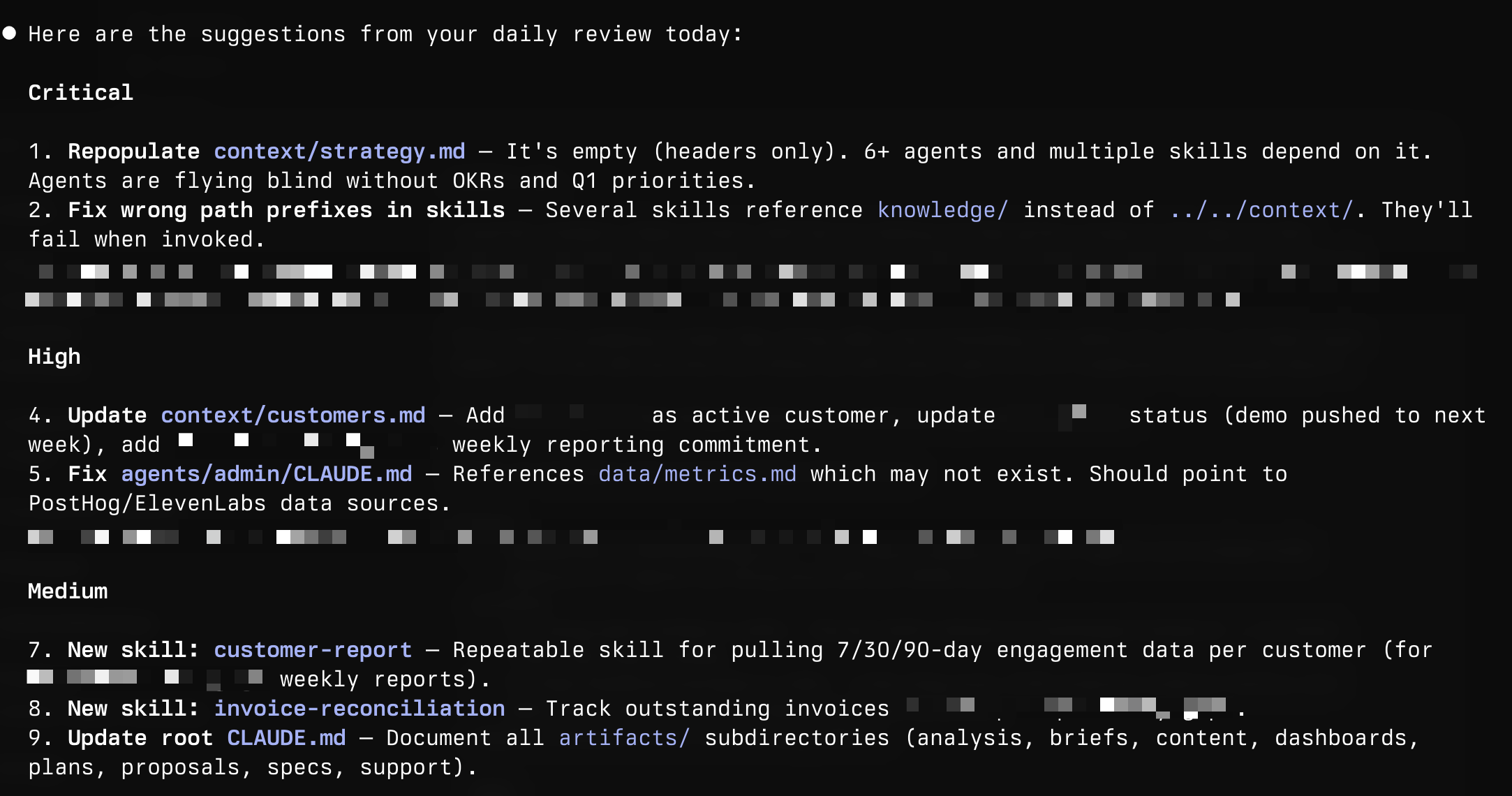
Every time I listen to it and make those tweaks, the next day runs a little smoother. The context is a little sharper. The skills are a little more dialed in. It compounds. Not in a vague inspirational way. In a real, tangible, I-can-feel-the-difference way.
The name is misleading
Here's what I wish more people understood. Claude Code has “code” in the name and that scares people off. They assume it's for developers.
I'm not sitting here writing Python all day. I'm describing what I want done and Claude handles the implementation. I say “pull my analytics for the last week and flag anything unusual” and it writes the script, runs it, and gives me the answer. I say “draft a launch post based on our recent release notes” and it builds the thing.
The bar isn't “can you code.” The bar is “can you describe what you want clearly.” That's it.
Why not just use chat or Cowork?
I get this question a lot. Especially now that Anthropic has three modes in the desktop app: Chat, Cowork, and Code. So let me break down how I think about them.
Chat is a conversation. You ask, Claude answers. It's great for thinking through problems, drafting ideas, getting quick answers. But it can't touch your files. It can't run scripts. Every conversation starts from zero.
Cowork is a big step up. It's built on the same agentic architecture as Claude Code but wrapped in a visual interface. You can point it at a folder, describe a task, and walk away. It'll organize files, create documents, process data. For a lot of people this is the right tool. You don't need to know the terminal. You describe the outcome and Cowork handles the steps.
But here's why I'm in Claude Code.
Claude Code lets you customize everything to your specific workflow. You can write scripts that automate your exact processes, pipe data through CLI tools, connect to APIs and MCP servers, and chain it all together into repeatable skills. It's not a general-purpose assistant. It's infrastructure you build around the way you actually work.
What I'm really saying
I'm not saying everyone needs to go build exactly what I've built. Your OS will look different from mine because your work is different from mine.
What I am saying is that Claude Code is wildly underestimated. Most people are using AI to write emails and summarize docs. And that's fine. But it's a fraction of what's possible.
You can build a system that knows your business, connects to your data, runs complex workflows, produces real deliverables, and gets better every day. That's not an AI assistant. That's something new. And the people who figure it out now are going to have a serious edge.
I'm all in because I've seen what happens when you stop treating AI as a tool you use and start treating it as a system you build.
It changes everything.